Dahlias
The dahlia year: not-so-easy steps to a patch that keeps giving
July 2026 · 8 min read
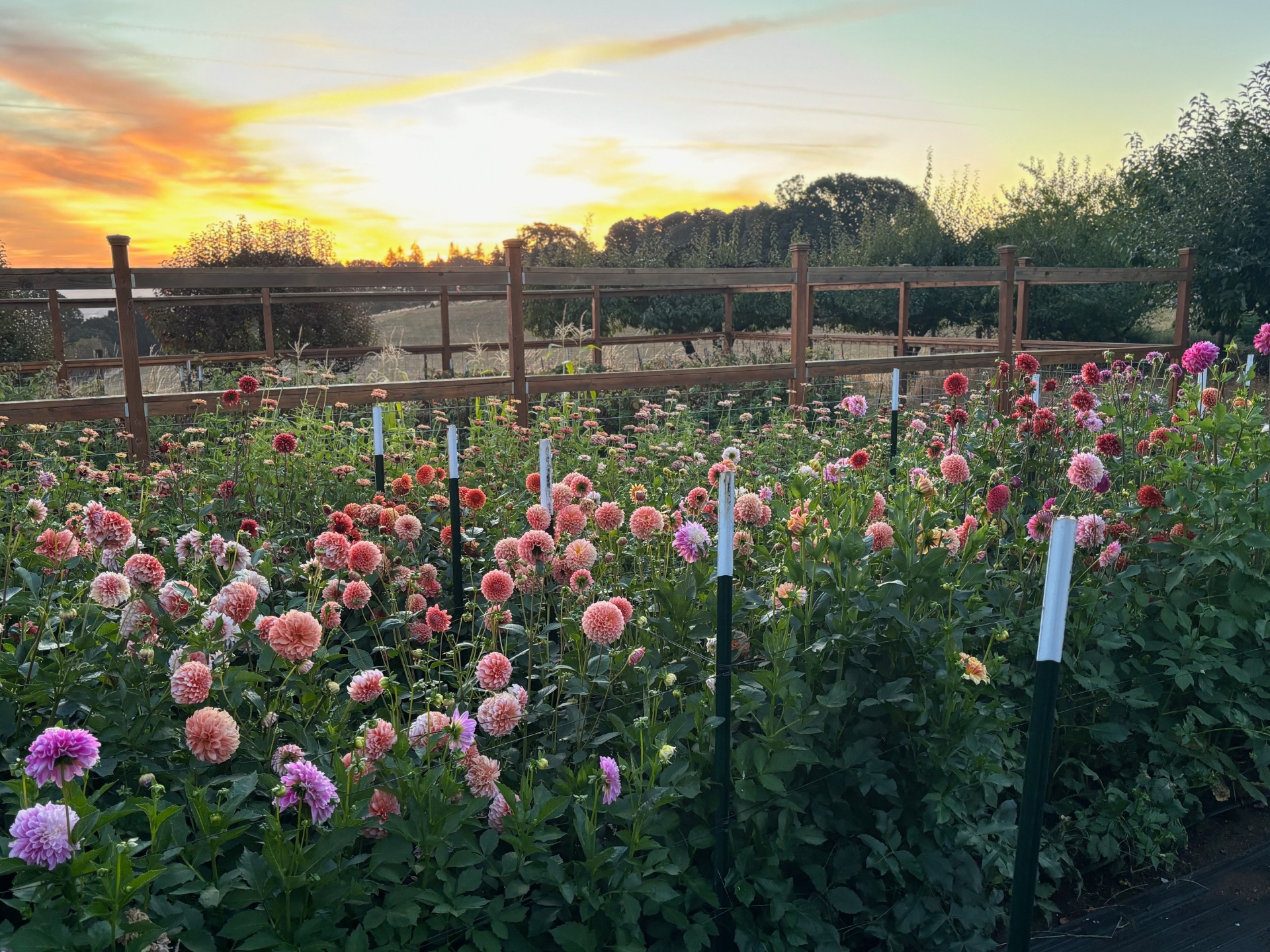
Dahlias are not a set-it-and-forget-it flower. They are lush, hungry, heavy-headed plants that need you at every turn — and if you show up for them, they will bury you in blooms from midsummer until frost. This is the full year, start to finish, the way I do it in my patch.
Planting
When the soil has warmed and the last frost is behind you, dig your holes four to six inches deep. I drop a handful of Biotone into each hole — it's a gentle, slow-release starter fertilizer that feeds the roots without shocking the tuber. Then I work a ring of Sluggo Plus into the surface soil around each planting. Slugs and snails love fresh dahlia sprouts the way children love candy, and if you don't stop them early, they'll mow down your tender shoots overnight. Sluggo Plus is iron phosphate with a spinosad boost, and it's allowed in organic gardening, which matters to me and to a lot of the gardeners I sell to.
Plant the tuber on its side, with the eye facing up, and cover it gently. Don't water until you see the first sprouts pushing through — a dormant tuber sitting in cold, wet soil is a tuber asking to rot.
Water
Once the sprouts are up, water often. Dahlias are lush plants — there's a lot of leaf and stem to support — and they do not forgive drought. A timer irrigation line or soaker hose is the optimal setup, because you can dial the run time up during heat waves and down when the weather cools, all without dragging a hose around at dusk. A dahlia that dries out will stall, and a stalled dahlia takes weeks to recover its momentum.
Pinching
Here is the hardest cut you'll make all year. When the plant has four sets of true leaves and you see the first tiny bud forming at the center, pinch it out — snip the growing tip just above the third pair of leaves. It feels brutal. You are removing the earliest, most eager flower the plant has to offer. But the dahlia responds by branching low, sending up three or four strong lateral stems where there was one. Those stems will be longer, straighter, and far more productive than the single central shoot you sacrificed. I still have to talk myself into it every spring.
The summer feed
By midsummer the initial Biotone has been spent, and the plants are pushing serious growth. I give them a second feed — again, something low in nitrogen like Biotone, or a bloom-boosting organic mix. Too much nitrogen at this stage gives you leaves and no flowers. You want phosphorus and potassium now, the nutrients that build stems and buds, not the ones that push green growth.
Staking
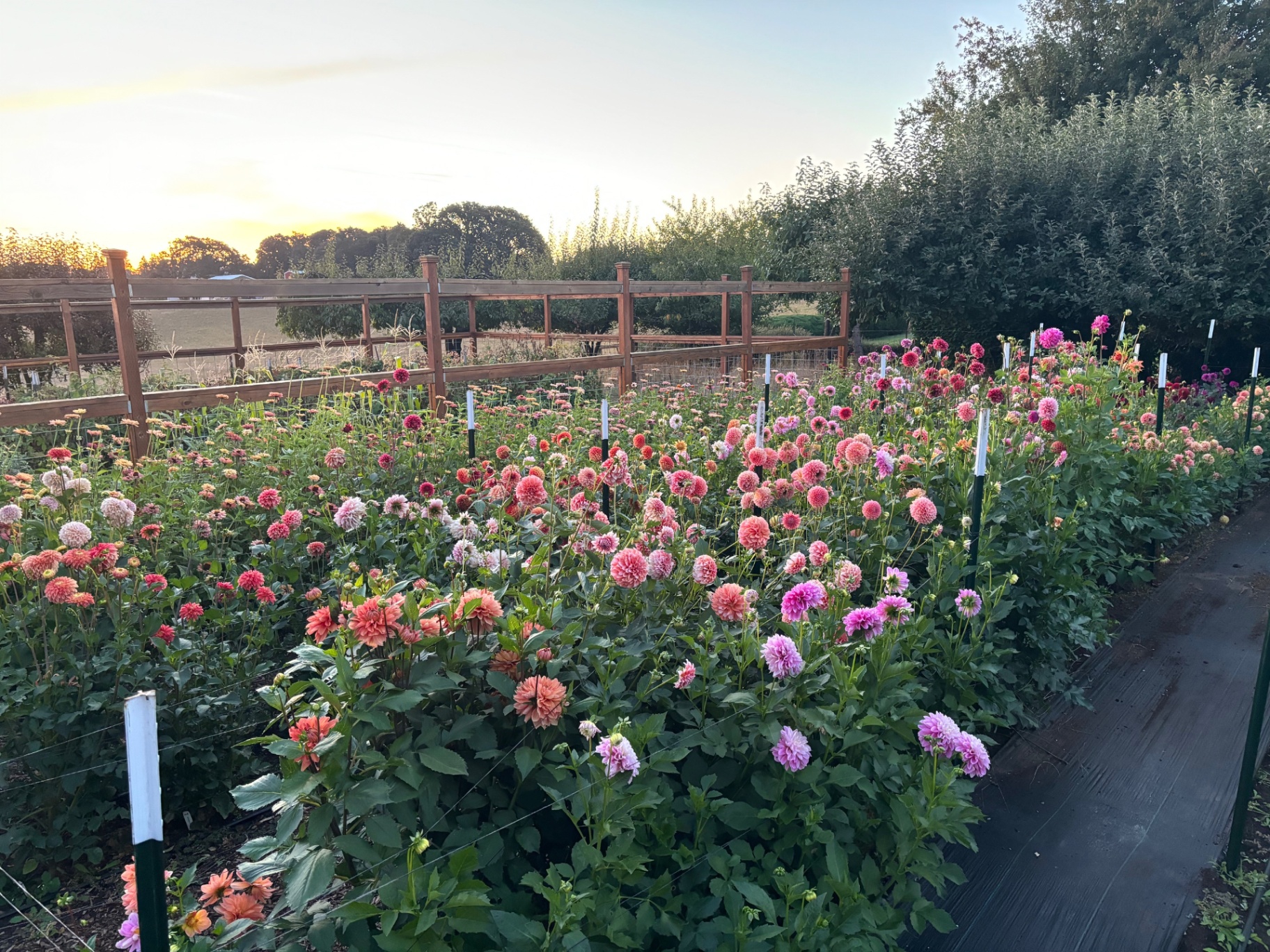
Dahlias are hollow-stemmed and top-heavy. A single thunderstorm can flatten a season's work in ten minutes, so I stake early — when the plants are still knee-high — rather than trying to rescue a leaning row in August. Skip the bamboo; you want a sturdy stake that stands five to six feet tall so it can carry the plant at full height. For my patch of 250-plus dahlias, I use the corral method: rows of stakes down each side of the bed, strung with twine at three horizontal heights as the plants grow. It's more work up front, and an absolute lifesaver in August when the stems are thick and the heads are heavy with rain.
Picking
Cut deep and cut often. Dahlias are a cut-and-come-again flower — every stem you take signals the plant to replace it with two. I cut in the cool of the morning, as low as I can reach, and plunge the stems straight into clean water. Dahlias do not open much after cutting, so take the bloom when it's mostly open or half-open, not tight. A tight bud in the vase will stay a tight bud.
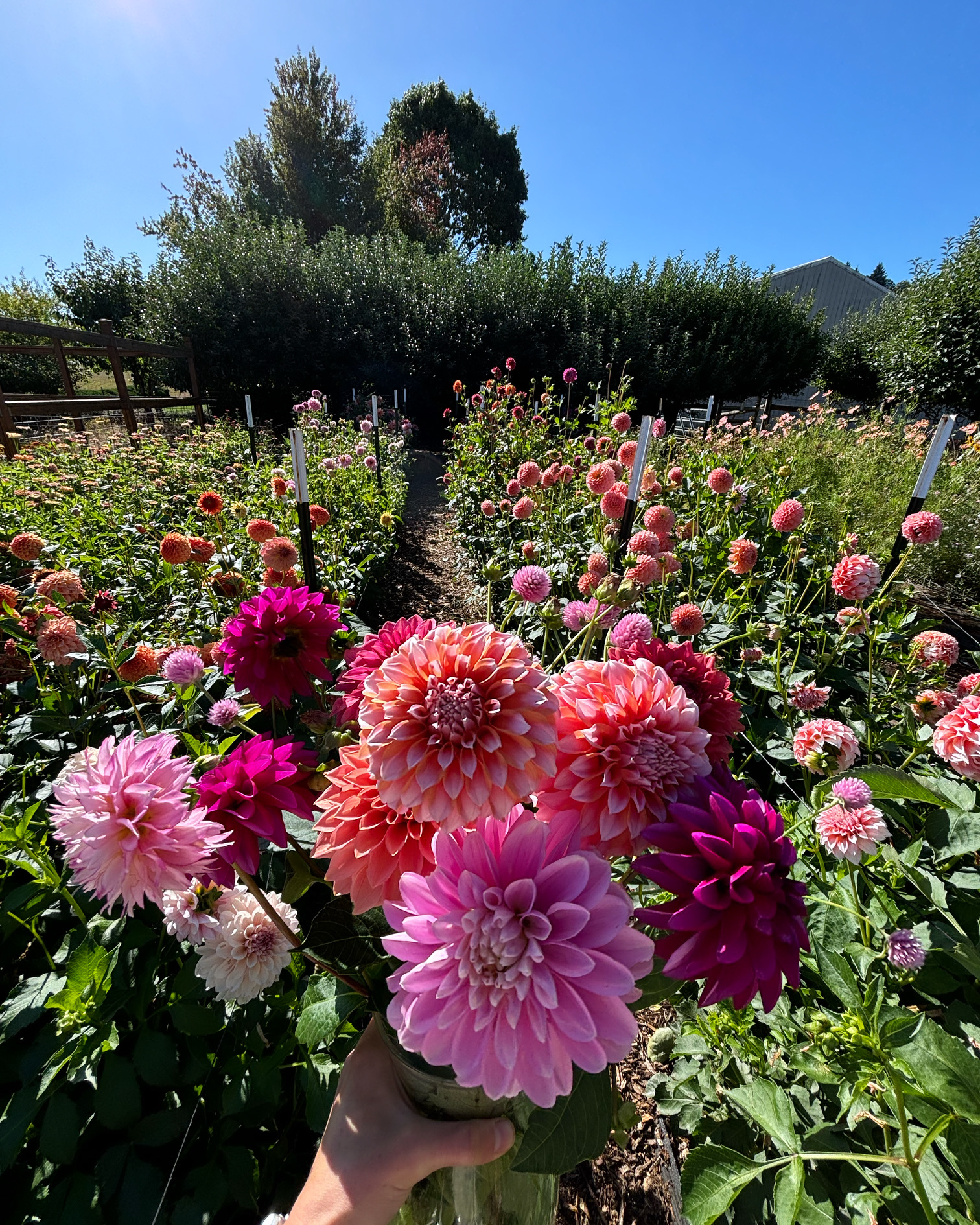
The more you pick, the more they give. A patch that is harvested every few days will outproduce a patch that is admired from a distance. If you want abundance, you have to meet the plant halfway.
The fall lift
When frost blackens the foliage, the season is over — but the work is not. In zones where winters are mild, you can leave the tubers in the ground with a heavy mulch. I garden where frost is guaranteed, so I wait for the first hard freeze, then cut the stems back to a few inches above the soil and lift the clumps carefully with a fork.
I skip the traditional cure. Instead, I hose the clumps clean right after digging and let them air-dry for twenty-four to forty-eight hours in a shaded, sheltered spot — never on concrete, which wicks the moisture out of the tubers and leaves them shriveled before you even get to storage. A wooden bench, a wire rack, or a layer of cardboard on a garage floor all work.
Then I divide the clumps. Each division needs an intact neck and a visible eye — the small, dormant bud that will sprout next spring. The eye is often right where the stem meets the tuber, and in older, shriveled tubers it can be hard to find. Work slowly, with good light. A division without an eye is just a snack for the compost pile.
For storage, I pack the divided tubers in vermiculite in shallow boxes, making sure they aren't touching each other. Too wet and they rot; too dry and they desiccate into hard, useless lumps. I drill a few holes in each box lid for airflow — a sealed box traps moisture and invites mold, and a little air movement keeps everything in balance. The goal is a cool, dark, stable environment — around 40 to 50 degrees, never freezing, never warm enough to break dormancy. I check them once a month through winter, removing anything that shows soft spots, and by February they are ready to wake up again.
Dahlias are not easy. They ask for more planning, more labor, and more attention through the full calendar than almost anything else I grow. But a healthy, well-tended dahlia patch in late August — waist-high, jeweled with color, humming with bees — is one of the most generous sights in the garden. The work is the price of admission, and the show, when it comes, is worth every hour.