Roses
A field guide to rose forms
August 2025 · 5 min read
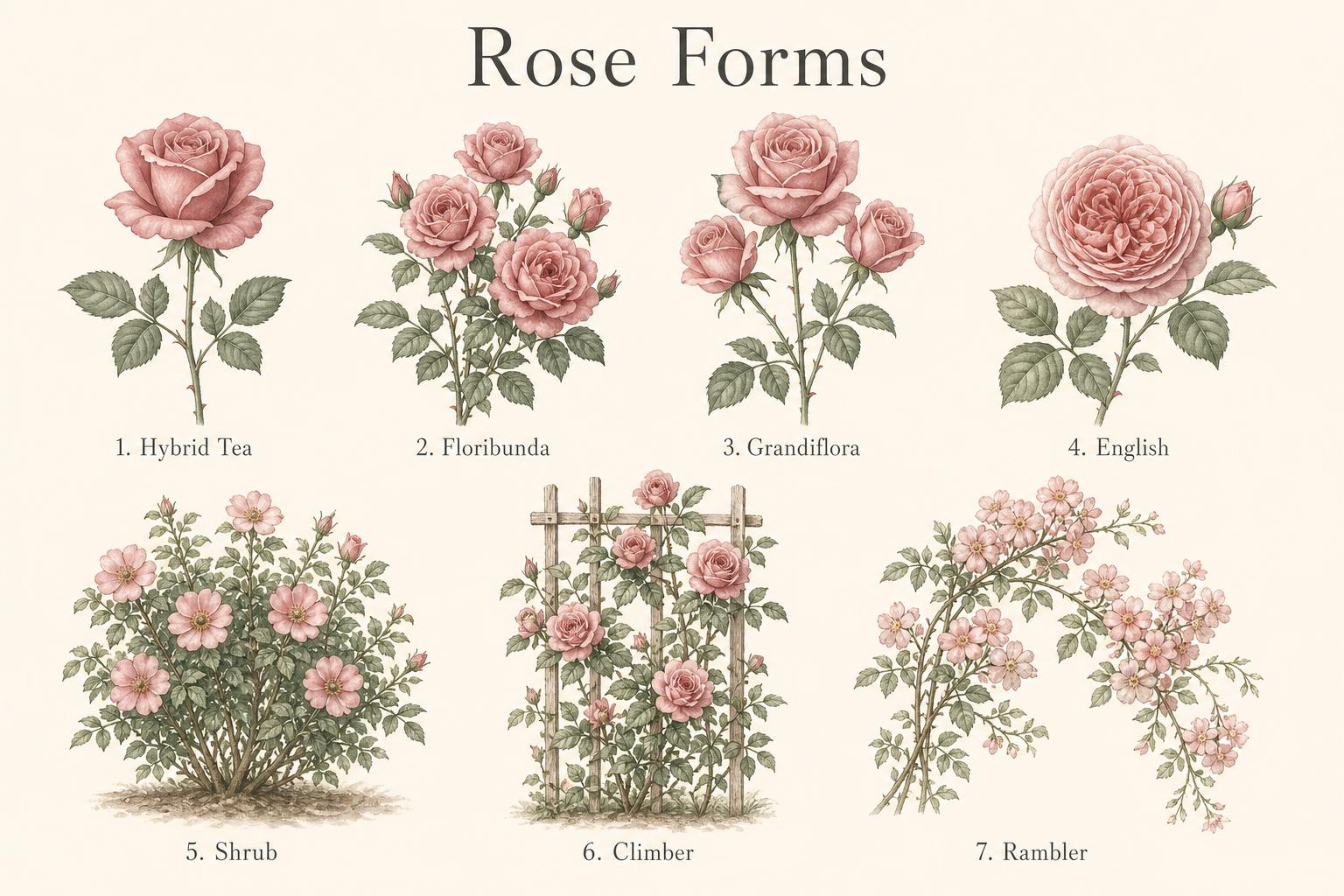
Open any rose catalog and you'll find dozens of category labels — hybrid tea, floribunda, grandiflora, shrub, English, climbing, rambling. The names can feel arbitrary until you understand that most of them are describing one of two things: how the plant grows, or what shape the flower opens into. Get clear on those, and the catalog starts to read like a map.
Hybrid teas are the form most people picture when they think 'rose.' One long stem, one high-centered bloom with a tight, spiraled center. They are the classic florist shape — elegant, formal, and bred for the vase. In the garden, hybrid teas tend to be upright and a little stiff, with sparse foliage; they reward a bed of their own more than a mixed border. Many of the older varieties have wonderful fragrance; many of the modern ones don't. Read carefully.
Floribundas trade size for abundance. Instead of one bloom per stem, you get clusters — five to fifteen smaller flowers opening together. The plants are bushier, more forgiving, and bloom in waves that carry the garden from early summer through frost. Floribundas are a favorite, and you'll find both floribundas and hybrid teas throughout our collection.
Grandifloras split the difference: hybrid-tea-sized blooms — often larger — carried in small clusters on taller plants. They give you the formal flower shape with more of the floribunda's productivity. Useful at the back of a border or against a fence.
English roses — while not officially their own form, popularized by David Austin for their cupped, high-petal-count blooms — are, in our eyes, a category of their own, and the style we carry the most of for that romantic cottage-garden feel. The plants tend to be shrubby and graceful, with the old-rose silhouette but the modern advantage of repeat blooming and (in the best varieties) genuine fragrance; the flowers nod gently from the stem in a way photographers love.
Shrub roses are the broad, useful middle of the category. They grow into rounded bushes, bloom heavily, and are bred for landscape use — disease resistance, cold hardiness, repeat bloom without much fuss. Knock Outs and the Drift series live here.
Climbers and ramblers describe how the plant grows, not what the flower looks like. Climbers send up long, stiff canes that can be trained along a wall or arbor; they tend to repeat bloom. Ramblers grow longer, more flexible canes and usually bloom once, spectacularly, in early summer. Both need structure to lean against — they don't actually climb on their own.
There's no hierarchy here. The right rose form is the one that matches how you garden. If you want long stems for the vase, look at hybrid teas and grandifloras. If you want a plant that does the work for you, choose a good shrub rose or an English rose with strong garden manners. The form tells you what you're getting.