Roses
Bare Root Rose Grades Explained: #1 vs #1.5
August 2026 · 5 min read
When you shop for bare root roses, you run into the same handful of labels everywhere: Grade #1, Grade #1.5, Grade #2. Most sellers list them and almost none explain them, which is a shame, because the grade is the single best predictor of how fast your rose establishes and how soon it blooms. Here is what each label actually measures, and what it means for the plant in your garden.
What grading actually measures
A grade is a shorthand for the size and readiness of a dormant rose. It describes two things: the number and thickness of the canes (their "caliper," measured at the bud union), and the development of the root system beneath them. A higher grade means a plant with more stored energy, more growing points, and a better root system to support them.
Grading exists because bare root roses are sold sight unseen, dormant and bare of soil. A label that says "Grade #1" is a promise about what is in the box before you ever open it. Without it, you are buying on faith. With it, you are buying on a standard.
Bare root rose grades
The American Standard for Nursery Stock defines three grades for field-grown, bare root roses. The differences are larger than they sound, and the jump from Grade #1.5 to Grade #1 is the one most gardeners misunderstand.
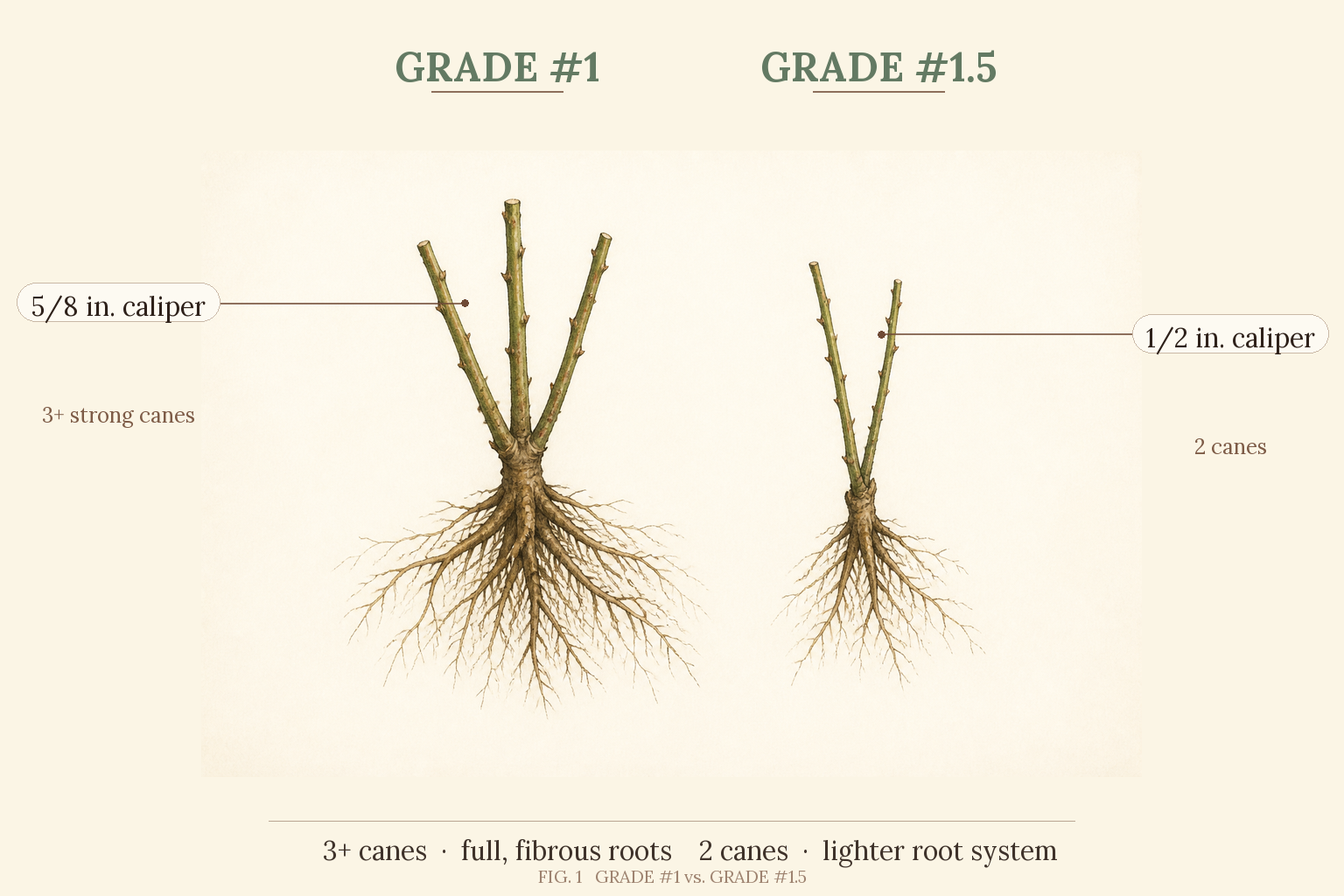
Grade #1, the top grade. A Grade #1 rose has at least three strong canes, each 5/8 inch or thicker in caliper at the bud union, plus a well-branched root system. This is a plant with enough stored energy and enough growing points to push vigorous new growth the first season and reach a respectable size by year two. If you want blooms sooner rather than later, this is the grade to buy.
Grade #1.5, the middle grade. Two or more canes, slightly thinner (roughly 1/2 inch caliper), with a good but lighter root system. A Grade #1.5 rose is a perfectly healthy plant that simply needs a little longer to size up. Expect strong establishment but a slightly smaller first-year show. We offer many of our David Austin varieties in both Grade #1 and Grade #1.5, because the lower grade makes rare English roses affordable to gardeners planting a whole bed.
Grade #2, the economy grade. One to two thinner canes, a smaller root system. Grade #2 roses are inexpensive, but they spend their first year catching up and may take two or three seasons to reach full size. They have their place (mass plantings, hedges, patient gardeners on a budget), but they are not the grade to plant where you want a statement by next summer.
What a higher grade buys you
1. Faster establishment. A Grade #1 rose with three strong canes and a full root system breaks dormancy with more energy reserves, pushes new growth sooner, and settles into your soil faster. A Grade #2 plant of the same variety, planted the same day, is usually a full season behind.
2. Earlier blooms. More canes mean more growing points, and more growing points mean more flowering wood. A Grade #1 rose will often produce a few blooms in its first season and a real flush by the second; a Grade #2 may take a third year to hit its stride.
3. Better survival through the first winter. A larger root system holds more reserves to regrow from if a hard winter knocks the canes back. This matters most in cold zones and for first-year plantings, which are the most vulnerable.
4. A truer-to-type plant with own-root stock. Grade tells you about size, but it is worth knowing how the rose was propagated too. Own-root roses, grown from cuttings on their own roots rather than grafted onto a different rootstock, are slower to size up but never sucker or lose their variety to a hard winter.
The grade is not a measure of quality, but a measure of readiness. A Grade #2 rose and a Grade #1 rose become the same plant, given time. The grade just tells you how much time.
How to compare grades across sellers
1. Ask for the grade in the listing. A seller who grades their stock will say so. If a listing mentions only the variety and the price, with no grade attached, you are buying blind, and a "bare root rose" with no grade is usually a Grade #2.
2. Compare price per grade, not per plant. A Grade #1 rose at $32 and a Grade #2 at $18 are not the same plant at different prices. One will bloom in a year; the other may take three. The cheaper plant can end up costing you more in lost seasons.
3. Check the root system, not just the top. Canes are the visible part, but the root system does the work. A good bare root rose has a full, fibrous root system proportional to the canes. Shriveled, soft, or broken roots are a red flag regardless of grade.
4. Confirm the propagation method. Own-root versus budded matters as much as grade for long-term performance. Own-root roses are slower to size but never lose their variety; budded (grafted) roses size up faster but can sucker from the rootstock and may need that sucker growth removed. Neither is wrong, but you should know which you are buying.
5. Read the guarantee. A seller who stands behind a Grade #1 plant with a one-year replacement guarantee is one who grades honestly and stores roots carefully. A guarantee is the surest sign that the grade on the label matches the plant in the box.
What we ship
At Cloverdale, our bare root roses are graded and labeled before they ship, inspected and packed by hand, and every plant is backed by our Cloverdale Commitment™ one-year thrive guarantee. The grade on the label is the plant you receive. That is the standard we hold, because a garden is a long conversation and the first year sets the tone for all of them.